Quick Answer: AEO (Answer Engine Optimization) is the process of optimizing your content so AI-powered search engines like Google, ChatGPT, and Perplexity can directly extract and display your answer. Unlike traditional SEO, AEO focuses on giving clear, structured, and direct answers to user questions — so your content becomes the source AI tools cite.
What is AEO? (AEO Meaning in Digital Marketing)
What is AEO? It stands for Answer Engine Optimization — a modern content strategy designed for the age of AI search.
In simple words, AEO is about making your content the direct answer that AI tools show when someone asks a question.
Here’s a quick breakdown:
| Term | Detail |
| Full Form | Answer Engine Optimization |
| Stands For | AEO |
| Primary Goal | Get cited as the direct answer by AI engines |
| Key Platforms | Google AI Overviews, ChatGPT, Perplexity |
| Content Focus | Questions, structured answers, schema markup |
Traditional SEO helps you rank on Page 1 of Google. AEO helps you become Page 0 — the answer that appears before any results.
If you are already familiar with how content optimization works, think of AEO as the next level — similar to how on-page SEO optimizes your content for Google, AEO optimizes it for AI-powered answer engines.
What Does AEO Stand For in SEO?
AEO stands for Answer Engine Optimization.
It refers to the practice of structuring your website content so that answer engines — like Google’s AI Overviews, ChatGPT, Perplexity, and Siri — can easily read, understand, and directly quote your content as the best answer.
In short: SEO gets you ranked. AEO gets you quoted.
What is Answer Engine Optimization and How Does it Work?
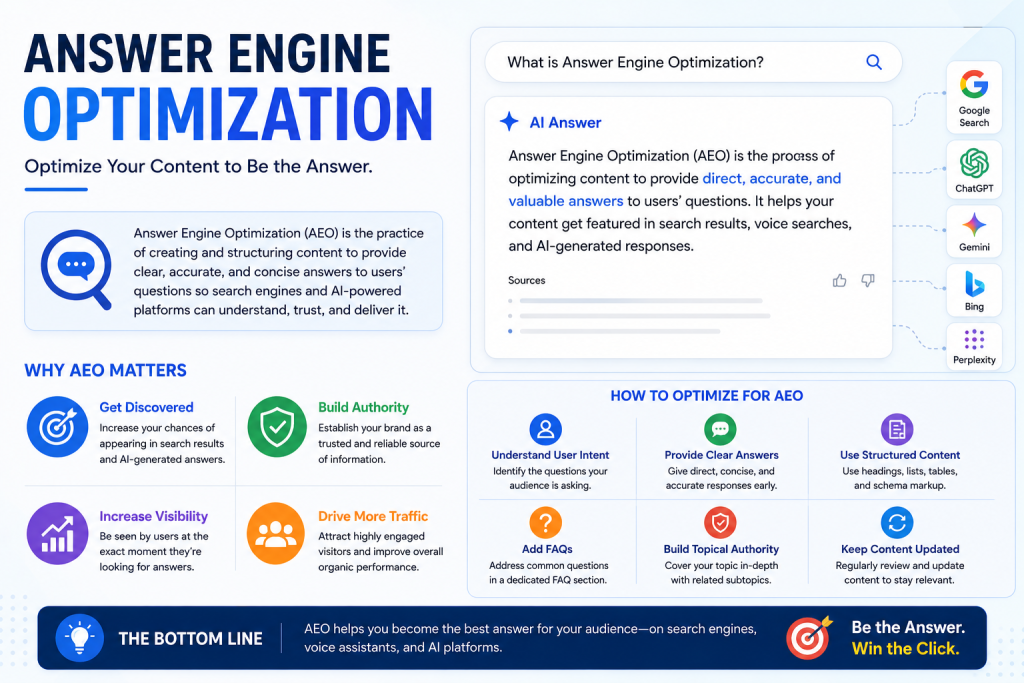
Answer engine optimization works by making your content easy for AI systems to extract and present as a direct response.
Here is how the process works step by step:
- A user asks a question — on Google, ChatGPT, Perplexity, or a voice assistant
- The AI scans indexed content — looking for structured, clear, and trustworthy answers
- The AI picks the best answer — and displays it directly, often citing the source website
For your content to be chosen, it must be:
- Clearly structured with question-based headings
- Directly answering the question in the first few lines
- Short and scannable — AI engines prefer concise answers
- Supported by schema markup so machines can understand it
The better your content answers questions, the higher the chance AI engines will cite your website.
AEO vs SEO — What is the Difference?
Many people confuse AEO with SEO. They work together — but they are not the same.
| Factor | SEO | AEO |
| Goal | Rank on Page 1 of Google | Be the direct answer shown by AI |
| Focus | Keywords & backlinks | Questions & structured answers |
| Platform | Google Search | AI Engines + Google Overviews |
| Content Style | Long-form articles | Direct, concise, structured |
| Success Metric | Rankings & organic traffic | Answer citations & zero-click visibility |
| User Behaviour | User clicks your link | User gets your answer without clicking |
The difference between AEO and SEO is simple — SEO drives clicks, AEO drives authority.
In 2026, the smartest websites are combining both strategies to dominate both traditional and AI-powered search.
How to Do AEO Optimization for Your Website — Step by Step
Now that you know what is AEO, let’s look at how to actually implement it.
Step 1 — Write Direct, Question-Based Content
Every piece of content should start by directly answering the main question in 2–3 sentences.
Do not bury the answer. AI engines scan the first 100 words first.
Step 2 — Use Structured Headings (H2 and H3 Questions)
Format your headings as questions — exactly how users type or speak them.
Instead of: “AEO Benefits” Write: “Why is AEO Important for Your Website?”
This makes it easier for AI to match your content to user queries.
Step 3 — Add Schema Markup (FAQ, HowTo, Article)
Schema markup is code that tells search engines exactly what your content means.
For AEO, use:
- FAQ Schema — for question and answer sections
- HowTo Schema — for step-by-step guides
- Article Schema — for blog posts and guides
Adding structured schema markup to your pages significantly improves your chances of being featured in AI-generated answers.
Step 4 — Keep Answers Under 50–70 Words
AI engines prefer short, precise answers.
Write your key answers in 50–70 words maximum. This is the sweet spot for featured snippets and AI citations.
Step 5 — Build E-E-A-T Signals
E-E-A-T stands for Experience, Expertise, Authoritativeness, and Trustworthiness.
Google and AI engines prioritize content from credible sources. Build E-E-A-T by:
- Adding author bios
- Citing trusted sources
- Publishing consistent, accurate content
- Earning quality backlinks
Why AEO Optimization Matters for AI Search in 2026
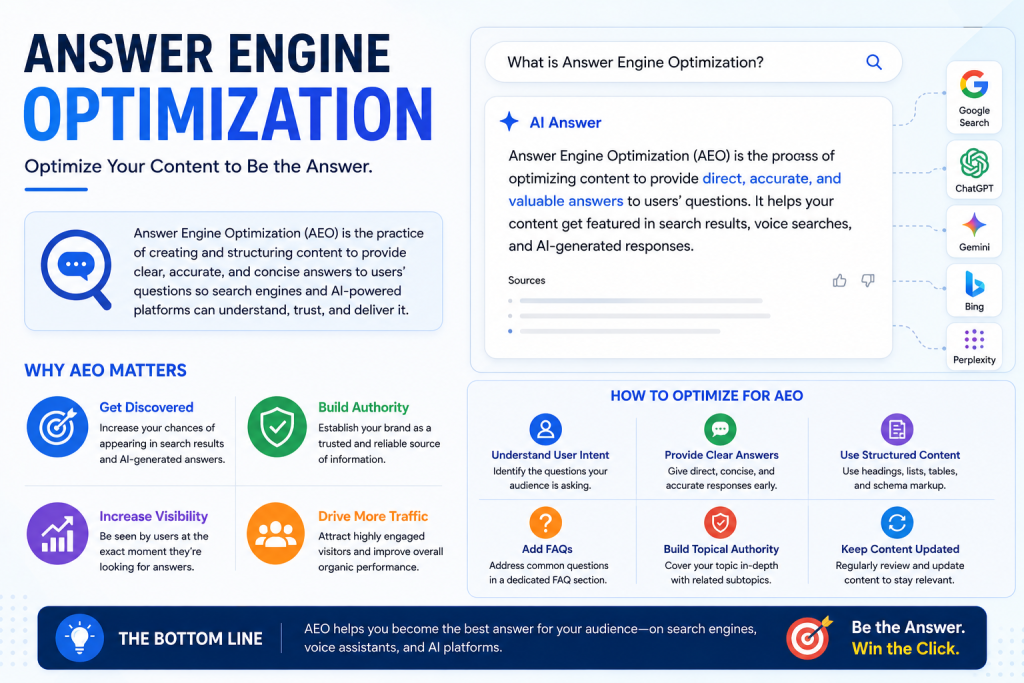
The way people search is changing — fast.
In 2026, users are no longer just typing keywords into Google. They are asking full questions to AI tools like ChatGPT, Google Gemini, and Perplexity — and expecting instant answers.
💡 Key Stat: Over 50% of Google searches are now zero-click. AEO helps you become the answer — not just a result.
If your content is not structured for answer engines, you are invisible to AI search — no matter how well you rank on traditional Google.
Here is why AEO matters right now:
- Google AI Overviews are replacing traditional blue links for many queries
- ChatGPT search is actively pulling content from websites to answer user questions
- Voice search relies entirely on direct, spoken answers — AEO content wins here
- Perplexity AI cites sources directly — AEO-optimized sites get free, high-authority visibility
Learning how to rank in Google AI Overviews in 2026 is now as important as ranking on Page 1 itself.
The brands that invest in AEO today will dominate AI search tomorrow.
Common AEO Mistakes to Avoid
Even well-intentioned content can fail at AEO if these mistakes are made:
- ❌ Writing long, vague answers — AI needs concise, direct responses
- ❌ Ignoring question-based headings — structure is everything in AEO
- ❌ Skipping schema markup — without it, AI engines struggle to understand your content
- ❌ Using jargon instead of simple language — AI favors plain, human-friendly writing
- ❌ Not structuring for featured snippets — if it won’t win position zero, it won’t win AI either
- ❌ Forgetting mobile and voice optimization — most AI queries come from mobile and voice devices
Avoiding these mistakes alone will put your content ahead of the majority of websites.
FAQ — Frequently Asked Questions About AEO
What does AEO stand for in SEO?
AEO stands for Answer Engine Optimization. It is the practice of structuring content so AI-powered search tools can extract and display it as a direct answer to user questions.
What is the difference between AEO and SEO?
SEO focuses on ranking your page in Google’s search results. AEO focuses on making your content the direct answer shown by AI engines like ChatGPT, Perplexity, and Google AI Overviews.
How does answer engine optimization work?
AEO works by formatting content with question-based headings, direct short answers, schema markup, and clear structure — so AI tools can easily read, understand, and cite your content.
Is AEO important for Google rankings in 2026?
Yes. With Google AI Overviews now appearing for millions of searches, AEO-optimized content gets featured directly — often before any traditional organic results.
Which AI engines does AEO target?
AEO targets all major answer engines including Google AI Overviews, ChatGPT, Perplexity AI, Microsoft Copilot, and voice assistants like Siri and Alexa.
Can small websites benefit from AEO optimization?
Absolutely. AEO levels the playing field — a small website with well-structured, direct answers can outperform large sites in AI citations, even with fewer backlinks.
Conclusion & Key Takeaway
What is AEO? It is the future of search visibility.
As AI engines become the first stop for millions of users, the websites that structure content for direct answers will win — regardless of their domain age or backlink count.
Start by writing clear answers, using question-based headings, adding schema markup, and building your E-E-A-T signals. Small, consistent steps in AEO today will deliver massive authority tomorrow.
Start optimizing your content for answer engines today — and position your website as the go-to source in the AI search era.
Digitvora is an SEO-focused digital platform that helps businesses improve search visibility, organic traffic, and online growth. We provide expert guidance on On-Page SEO, Technical SEO, Keyword Research, AEO, and content optimization to help websites rank higher and build lasting authority in search engines and AI-driven search experiences.